White Papers
Economic and Operational Benefits of Natural Gas Generators
7 MIN

Introduction
In an increasingly dynamic energy landscape, businesses and critical infrastructure demand reliable, efficient, and economically viable power generation solutions. While traditional diesel generators have long served as the standard for emergency standby power, the evolving market, environmental considerations, and advancements in technology are highlighting the advantages of natural gas generator solutions. This paper examines the comprehensive total cost of ownership (TCO) and significant operational benefits that natural gas generators offer, demonstrating their long-term economic advantages and strategic value. Natural gas, as a readily available and cleaner-burning fuel, presents a compelling alternative for emergency standby and demand response applications. Beyond the initial capital investment, a holistic view of ownership costs reveals substantial savings and operational efficiencies that can significantly impact an organization’s bottom line and operational resilience.
Total Cost of Ownership (TCO) Analysis
The total cost of ownership extends beyond the initial capital expenditure. TCO encompasses all costs associated with acquiring, operating, and maintaining a generator throughout its service life, typically 20-25 years. For natural gas generators,
this analysis consistently reveals a more favorable long-term financial outlook compared to other fuel types.
Capital Costs
While the initial capital expenditure for natural gas generators can be higher than diesel units of similar capacity, this difference is often offset by reduced infrastructure requirements and the elimination of certain recurring costs. For instance, natural gas units do not require large, dedicated on-site fuel storage tanks, which can be a significant cost and space consideration for the project. The connection to an existing natural gas pipeline simplifies fuel logistics and eliminates the need for fuel deliveries.
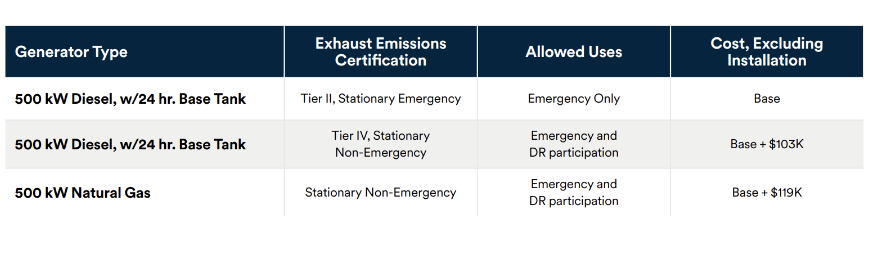
The example below illustrates nominal pricing for various 500 kW generator sets equipped with sound attenuated enclosures. While the Tier II diesel engine has a substantially lower initial cost compared to the Tier IV diesel or the natural gas engine; only the latter two meet the tight exhaust emissions limits required to participate in demand response programs.
Fuel Costs
Fuel represents one of the most substantial ongoing operational costs for any generator. Natural gas typically offers an advantage in this area due to its:
Reduced Maintenance Expenses
Natural gas generators generally incur lower maintenance costs over their operational life due to several inherent characteristics of the fuel and engine design:
Opportunities for Revenue Generation: Demand Response Programs
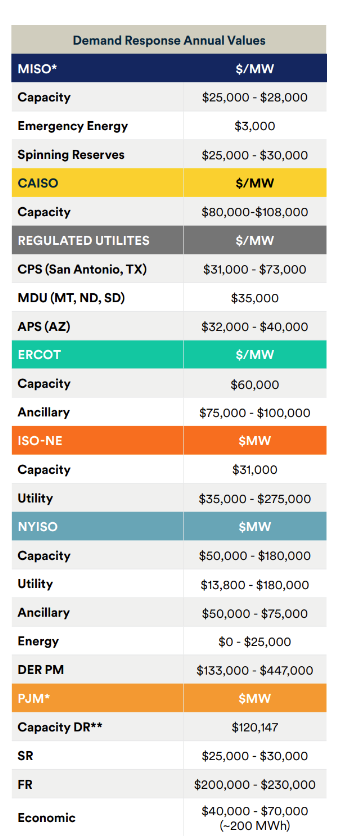
Beyond cost savings, natural gas generators can transform from a pure cost center into a potential revenue stream through participation in demand response (DR) programs. These programs, offered by utilities and grid operators, incentivize customers to reduce or shift their electricity consumption during periods of high demand or grid instability.
By utilizing their natural gas generators to offset grid power during peak times, businesses can earn significant payments from utilities. This not only enhances the economic viability of the generator investment but also contributes to grid stability and energy independence. The continuous fuel supply of natural gas units makes them ideal candidates for sustained participation in such programs.
The financial incentive for participating in demand response programs can overcome the higher initial purchase cost of a generator set equipped with an engine certified to meet the tighter non-emergency emissions standards. In some markets, a DR enabled generator set can show a positive return on investment over its operating life.

OPERATIONAL FLEXIBILITY AND SCALABILITY
Modern natural gas generator solutions offer operational flexibility and scalability, allowing businesses to adapt their power generation capabilities to evolving needs.
PARALLELING MULTIPLE GASEOUS-FUELED UNITS
The ability to parallel multiple natural gas-fueled units provides several key advantages:
RAPID START AND BLOCK LOAD TRANSIENT RESPONSE
Natural gas engine technology has improved dramatically over the past decade. Today, natural gas generators exceeding 1,000 kW are capable of starting in under 10 seconds (NFPA 110 Type-10), ensuring that critical loads are quickly supported during power outages. Most rich-burn engines can accept a 100% block load in a single step.
Conclusion
The adoption of natural gas generator solutions offers a compelling value proposition for organizations seeking reliable, cost-effective, and environmentally responsible power. Through a comprehensive TCO analysis, it becomes clear that the long-term economic advantages, stemming from lower and more stable fuel costs, reduced maintenance expenses, and the elimination of complex fuel logistics, far outweigh initial cost considerations. The ability to generate revenue through demand response programs and the inherent operational flexibility and scalability of paralleled natural gas units support their widespread use for modern power generation needs.


