White Papers
Battery Energy Storage for Emergency Power Systems
5 min read
As commercial and industrial (C&I) facilities face rising energy costs and more frequent grid instability, the conversation around emergency power has expanded from traditional engine-generators to include Battery Energy Storage Systems (BESS). This transition is driven by three factors: reducing a facility’s carbon footprint, the ability to provide life-safety backup while simultaneously monetizing the asset during normal operations. However, successful implementation requires a rigorous understanding of the unique electrical characteristics of battery systems, stringent fire safety codes, and the economic “value stack” required for a viable return on investment (ROI). This paper examines the technical, regulatory, and economic considerations for utilizing BESS as a Stored Emergency Power Supply System (SEPSS).
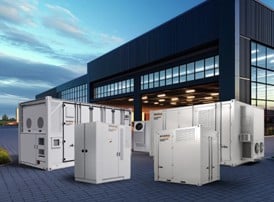
For any system designated to support emergency loads, compliance with NFPA 111, Standard on Stored Electrical Energy Emergency and Standby Power Systems, is the primary benchmark. NFPA 111 defines performance requirements for Stored Energy Power Supply Systems (SEPSS) based on the type of load they serve—ranging from life-safety (Type A or B) to optional standby (Type M).
While NFPA 111 governs the performance of the system as an emergency source, NFPA 855, Standard for the Installation of Stationary Energy Storage Systems, governs the physical installation and safety of the battery itself. Key updates in the 2026 Edition of NFPA 855 have removed prior 600 kWh capacity limits for rooftops and open parking garages, facilitating larger deployments in dense urban environments. Furthermore, the code now mandates both UL 9540A thermal runaway testing and Large Scale Fire Testing (LSFT) to determine safe separation distances from buildings and between adjacent units.
A critical distinction in BESS design is the difference between power (kilowatts) and energy (kilowatt-hours).
Sizing for dual-use applications requires an additive approach to energy capacity. Per NFPA 111 Section 7.2.2.1, where an SEPSS is used for purposes other than emergency or standby power (such as demand charge management), the energy storage system must maintain sufficient reserved capacity to provide the required emergency power after those other uses have been completed. This means the system must be sized to meet the energy management objective while always maintaining a sufficiently high state of charge (SoC) to meet the runtime requirements for the emergency role. While this increases the total energy storage requirement and initial capital expenditure, it offers a significant technical advantage: most of the time, the Depth of Discharge (DoD) will be less than 50%. This shallow cycling reduces stress on the cells, leading to an exceptionally long cycle life and protecting the long-term health of the asset.
A common challenge in building backup is sizing for elevators and other large motors. Traditional passenger elevators often exhibit high starting currents, potentially 5–7 times their full-load running current. This requires the BESS inverter to be sized significantly larger than the steady-state load to prevent overload shutdown during motor start.
Use of soft-starters or VFDs can significantly reduce the motor inrush current, bringing the inverter size closer to the maximum anticipated running load. Significantly, BESS inverters are largely unaffected by harmonic current distortion from non-linear loads. They can maintain a sinusoidal voltage waveform despite significant non-linear loads.

Relative to traditional diesel generators, a BESS has a much lower energy density. For context, one megawatt-hour (1 MWh) of battery storage is approximately equivalent to 70 gallons of diesel fuel consumed by a diesel generator. While a generator can run indefinitely with a steady fuel supply, a BESS will have a more limited runtime during a utility outage until it can be recharged via the grid or on-site renewables. Consequently, a BESS is most effective for emergency systems where required runtimes are modest—typically 4 hours or less—and loads are predictable.
Energy storage is widely considered an economic problem before it is an engineering problem. A BESS dedicated solely to emergency standby will never achieve a positive ROI if it sits idle most of the time. To justify the higher capital expenditure compared to an emergency engine-generator, the system must be monetized daily through one or more of the following:
Fire safety remains the primary hurdle for BESS in urban commercial and industrial applications. Developers should specify UL 9540 Listed products, which certify the safety of the battery, inverter, supporting sub-systems, and the enclosure as a complete system.
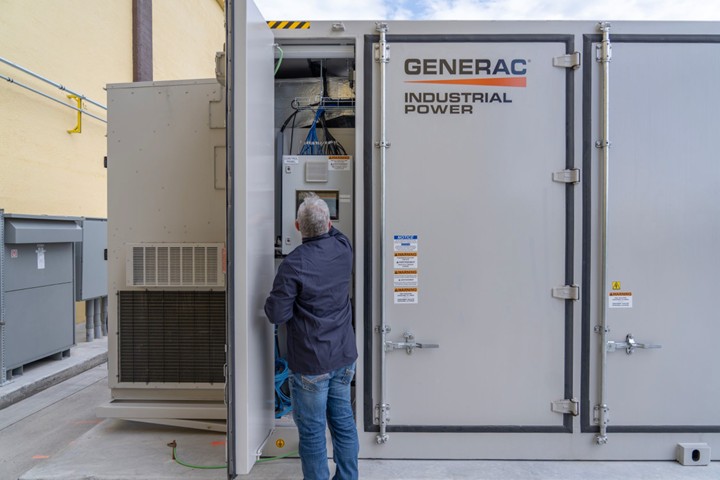
The decision to utilize BESS for emergency power is a balance of resilience and revenue.
For many C&I clients, a practical microgrid design compromise is a hybrid approach: a BESS for daily energy management and short-duration ride-through, paired with a traditional generator for long-term resiliency.
Michael Hainzl is a Senior Power Solutions Manager for the Northeast US at Generac Industrial Energy. An electrical engineer with over 30 years of experience, he specializes in resilient design for critical power systems. Michael is also an active volunteer firefighter with 40 years of service, bringing a unique perspective on battery safety, fire prevention, and emergency preparedness to the field of energy storage.