Solar & Battery Solutions

A Homeowner’s Guide to Solar Financing in 2026: Loans, Leases, Cash & More

10 MIN May 25, 2026

Explore payment options for solar panels and other home energy solutions 

Rising electricity costs—and a growing reliance on electric power in the home—are changing how homeowners think about energy. From large HVACs and heat pumps to smart home devices and EVs, today’s homes are using more electricity than ever before.  
 
Installing solar panels can help offset rising energy costs—but the expiration of the residential 30% ITC tax credit is changing the way homeowners think about the investment.

The good news? Solar is more accessible than ever and there are still ways to benefit from the 30%* federal tax credit in 2026. 

There are a range of solar panel financing options designed to fit different budgets and goals whether you’re looking for no upfront cost, predictable monthly payments, or the ability to bundle solar with backup power solutions like solar battery storage or a home backup generator, there’s an option that can work for you. 


*10% Solar Tax Credit Adder
Even with a below-normal outlook, it only takes one landfall - along the Atlantic or Gulf coast - to make it an active season where you live. And recent history is a clear reminder of the devastation that hurricanes can deliver even far beyond the shoreline.


Solar Loan: Ownership with Monthly Payments

A solar loan allows you to own your system from day one without the upfront investment. Many lenders offer $0 down payment plans, however interest rates vary and can decrease the overall return over the life of the system when compared to paying cash.
Why homeowners choose it:
  • Little to no upfront cost
  • You still own the system
  • Fixed monthly payments in many cases
  • Some lenders may cover the cost of solar, battery storage, and home generators
Things to consider:
  • Total cost is higher over time compared to cash due to interest
  • Loan terms and rates vary by lender
  • As the system owner, you are responsible for maintenance and repairs
  • Not eligible for 30% federal tax credit
For many homeowners, a solar loan strikes a balance between affordability and ownership. Monthly payments are often designed to align with—or fall below—what you were previously paying your utility company, while you still benefit from offsetting utility costs with solar power.

Solar Lease: Low Upfront Cost Without Ownership

With a solar lease, a third-party provider installs, owns, and maintains the system, and you pay a fixed monthly fee to use it over a set term—typically 20–25 years. Most solar leasing companies offer $0 down options and monthly payments can even be lower than your current utility bill. 
 
In some cases, this structure is marketed as a subscription model, where you’re paying for ongoing access to solar energy without owning the equipment. 
 
Where the 30% federal tax credit comes in: The  residential tax credit  may have expired at the end of 2025, but with third-party ownership (TPO), the solar leasing company still qualifies for the 30%  commercial tax credit and is able to pass on savings over the life of your lease.
Why homeowners choose it:
  • Little to no money down
  • Fixed monthly payments
  • Service and maintenance obligations are typically handled by the provider
  • Some providers may cover the cost of solar, battery storage, and home generators
  • Leases can typically be transferred to a new homeowner in the case that you sell
Things to consider:
  • You don’t own the system
  • Long‑term savings are typically lower than cash or prepaid lease options
  • Only system owners are eligible for state-level tax incentives or rebates
  • Some plans may include a rate accelerator that increases your payments over time
Leases can be attractive for homeowners who want to avoid upfront costs and ownership responsibilities, while still benefitting from savings from solar and backup power if battery storage and/or a home generator is included.

Power Purchase Agreement (PPA): Pay Less for the Power You Use 

A PPA is another third‑party ownership option offering low or no upfront costs, but instead of a fixed monthly lease payment mentioned above, you pay for the actual electricity the solar panels produce, typically at a lower rate than your utility. 
 
Similar to a standard solar lease, the solar leasing company still qualifies for the 30% solar tax credit and should factor in those savings to your rate.
Why homeowners choose it:
  • Little to no money down
  • You pay for energy at a set rate, often lower than utility electricity
  • Service and maintenance obligations are typically handled by the provider
  • Some providers may cover the cost of solar, battery storage, and home generators
Things to consider:
  • You don’t own the system
  • Long‑term savings are typically lower than cash or prepaid lease options
  • Monthly costs vary based on usage
  • Only system owners are eligible for state-level tax incentives or rebates
Because you’re paying for power rather than equipment, it can feel similar to a traditional utility bill—just with a lower rate and powered by solar.

Prepaid Solar Lease: Lower Cost Path to Ownership

A prepaid solar lease offers a hybrid approach between ownership and traditional leasing. Instead of making monthly payments, you pay upfront for the system’s expected energy production over the life of the agreement, often at a discounted rate.  
 
The solar leasing company still installs, owns, and maintains the system while under lease, and is able to pass on savings from the 30% commercial solar tax credit
 
System ownership can then be transferred to the homeowner after a defined period, but no sooner than year six based on federal tax credit eligibility rules.
Why homeowners choose it:
  • Lower total cost than many traditional cash, lease, or loan options
  • No ongoing monthly payments for energy from the system
  • Service and maintenance obligations are typically handled by the provider while under lease
  • Opportunity to take ownership of the system after a set period
  • Certain providers will cover the cost of solar and battery storage systems
Things to consider:
  • Requires an upfront payment (or financing for that payment)
  • You don’t own the system during the initial term
  • Terms and buyout options vary by provider 
  • Only system owners are eligible for state-level tax incentives or rebates 

For homeowners looking to balance upfront savings, long-term value, and future flexibility, a prepaid lease can be a compelling middle ground between owning and leasing a system. 

Cash Purchase: Maximum Long‑Term Value 

Paying cash means purchasing your home energy system outright—whether that’s solar panels only, or you opt to include solar battery storage and/or a home backup generator for resilience. Because you're not making loan or lease payments, the energy savings go directly to your bottom line—maximizing your long-term savings on utility costs.
Why homeowners choose it:
  • You own the system from day one
  • No monthly loan, lease, and in some cases, energy payments
  • High long‑term return
  • Take advantage of local incentives and rebates
Things to consider:
  • Requires a higher upfront investment
  • Payback happens over time, not immediately
  • As the system owner, you are responsible for maintenance and repairs
  • Not eligible for 30% commercial tax credit
A cash purchase often makes sense for homeowners who plan to stay in their homes long term and want to maximize value over the life of the system. Once the upfront cost is paid, the energy your system produces can significantly reduce your reliance on the grid.


Solar Battery Storage

How Integrated Home Energy Solutions Are Changing the Conversation


Today’s home energy decisions are about more than just saving on utility bills—they’re about building a more resilient, flexible home energy system. 
 
As the grid faces increasing strain from aging infrastructure, severe weather, and rising demand, outages in many areas are becoming more frequent and longer-lasting. That reality is prompting more homeowners to rethink how they power their homes—not just for savings, but for greater control and peace of mind. 
 
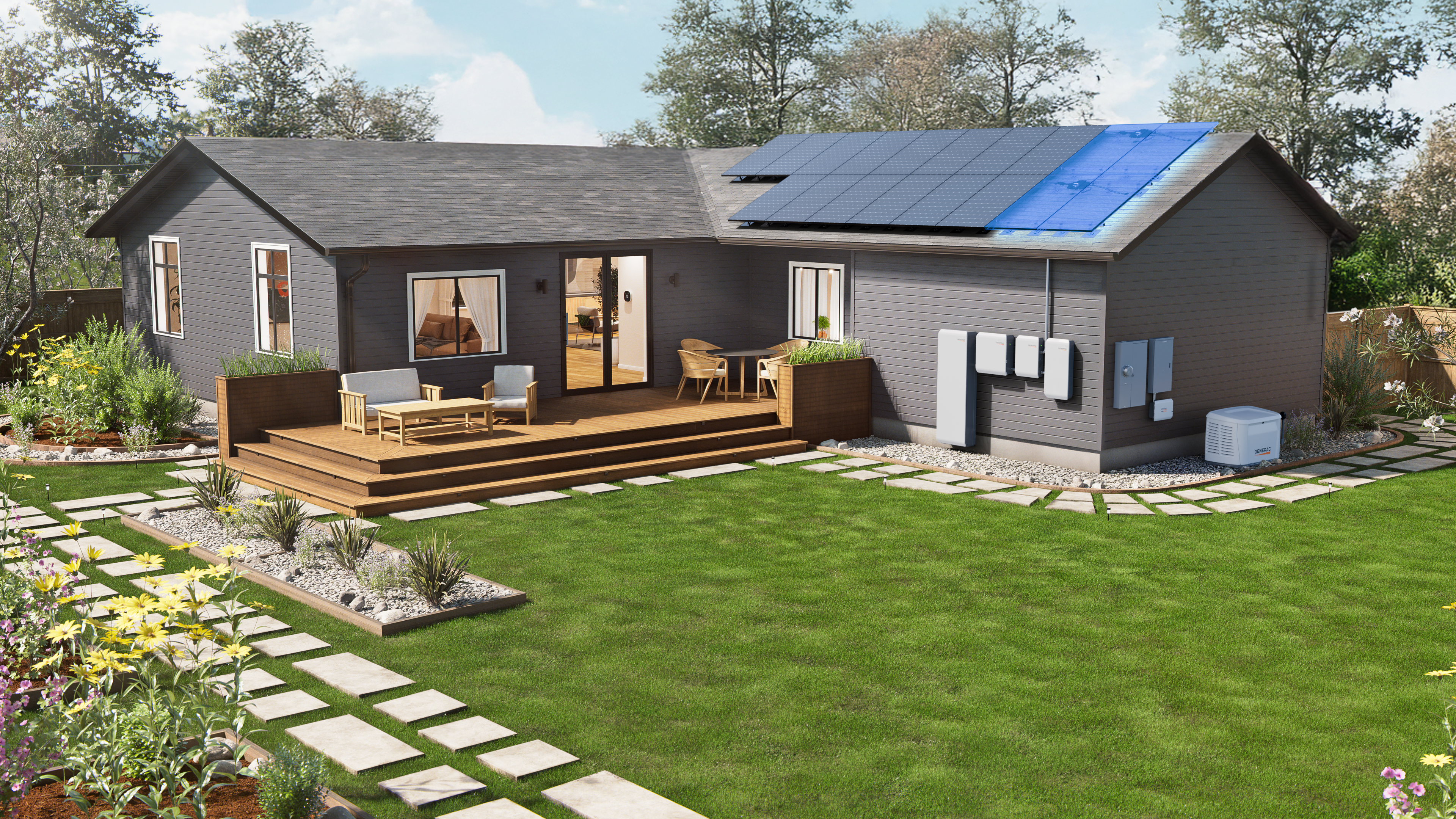
Instead of evaluating solar, battery storage, or backup generators in isolation, more homeowners are considering how these technologies work together as part of an integrated home energy system. 
 
And importantly, how you pay for that system plays a key role in what’s possible. Your payment approach can influence: 

  • How much backup you can afford, from battery storage capacity to generator size 
  • How easily your system can evolve over time, whether you want to add storage or expand later
  • How predictable your monthly energy costs are, and how quickly you begin to see savings 

In other words, financing isn’t just about affordability—it can shape the flexibility, resilience, and long-term value of your home energy system. 


Solar Battery Storage

Which Solar Financing Option Is
Right for You?


Rather than ranking payment options from “best” to “worst,” it’s more helpful to think about your long-term goals and what you value most: 

  • Best long-term return: Cash purchase or prepaid lease 
  • Lowest upfront investment: Loan, lease, or PPA
  • No monthly payments: Cash purchase or prepaid lease
  • Predictable monthly payments: Lease or loan
  • System ownership: Cash purchase, load, or prepaid lease
  • Lowest ownership commitment: Lease or PPA 
  • Captures 30% tax credit: Lease or PPA 

Every home, budget, and energy goal is different. The best payment option is the one that aligns with how you want to use energy in your home—today and in the future. 

  Solar Loan Solar Lease Power Purchase Agreement
Upfront Cost Low to none Low to none Low to none
Lifetime Savings Moderate potential Moderate potential Moderate potential
Ownership Homeowner Third Party Third Party
Monthly Cost Fixed Fixed Variable
Maintenance Responsibilities Homeowner responsible Third-party owner responsible Third-party owner responsible
Indirect Eligibility for 30% Federal Tax Credit No Yes Yes


Frequently Asked Questions

Have questions? We’ve answered some of the most common ones. If you don’t see what you’re looking for, your local dealer can help with answers specific to your home, or visit our Support Center for more details.

Homeowners typically have several ways to pay for solar panels and related home energy solutionsincluding: cash purchase, loan, lease, Power Purchase Agreement (PPA), and prepaid leaseEach option offers a different combination of upfront cost, monthly payments, ownership, and long-term value.  

There’s no single “best” financing option—it depends on what matters most to you. The best option for you will be one that aligns with your financial capabilities and goals, how long you plan to stay in your home, and whether you’re looking to build a more comprehensive home energy system over time.

  • Best long-term return: Cash purchase or prepaid lease
  • Lowest upfront investment: Loan, lease, or PPA
  • No monthly payments: Cash purchase or prepaid lease
  • Predictable monthly payments: Lease or loan
  • System ownership: Cash purchase, loan, or prepaid lease
  • Lowest ownership commitment: Lease or PPA
  • Captures 30% tax credit: Lease or PPA

The main difference comes down to ownership. 

With a solar loan, you borrow money to purchase the system and own it from day one. This allows you to benefit directly from energy savings and system ownership over time.

With a solar lease, a third-party provider owns the system, and you pay a fixed monthly fee to use it over a set term. Because a third-party provider owns the system, leased systems are also eligible for the 30% solar tax credit.

Solar financing allows homeowners to install solar panels without paying the full cost upfront. The goal is to make solar more accessible by spreading out costs over time or reducing upfront investment.

Depending on the option you choose, you may:

  • Make monthly loan payments towards ownership
  • Pay a fixed monthly lease payment to use the equipment
  • Pay for the energy produced (PPA) without owning the system
  • Prepay the lease cost upfront at a discounted rate

Some options also allow you to bundle additional components, like battery storage or a backup generator, into a single financing structure.

For many homeowners, solar financing makes going solar more accessible by removing the need for a large upfront investment. That means you can begin capturing savings on your energy bills sooner, with overall value depending on your financing terms, energy usage, local utility rates, and how long you plan to stay in your home.

Yes—some financing providers offer packages to finance solar panels and battery storage as part of the same payment plan.

Bundling solar and storage can:

  • Provide backup power during outages
  • Help you store and use more of your solar energy
  • Simplify installation and financing into a single plan

Yes, as the home energy market evolves, more lenders and providers now offer bundled financing options that can include solar, battery storage, and backup generators. This approach allows homeowners to combine savings from solar with reliable backup power, often with low or no upfront cost.


The Generac Advantage

Generac has been a leader in home backup power for decades. With a range of flexible home energy solutions including solar power, battery storage, backup generators, and smart energy management—our products are designed to work together seamlessly, providing homeowners with:

Proven Reliability

Automatic Operation

Professional Installation & Service

Scalable Home Energy Solutions


Your local Generac dealer can assess your home’s energy needs and recommend the right home energy solution, and payment plan, for your home. 

Connect with a Dealer

Sources cited

  1. https://www.consumerreports.org/homeowners-insurance/home-improvements-that-can-save-you-money-on-homeowners-insurance/?srsltid=AfmBOop3lVjpM97ZjhqifAuIjcCQR68Glry6Rh0zqNtpseK6BcI7VXNJ

Related articles