Solar & Battery Solutions

Fueling Your  Home Generator: What Type of Gas Do Generators Use?

4 MIN May 15, 2026


Key Takeaway: What Type of Gas Do Whole-Home Generators Use?

Most home standby generators run on natural gas or liquid propane. Natural gas connects to a utility line, while propane is stored in an on-site tank. The best choice depends on your home’s fuel access, outage planning needs, local infrastructure and whether you want continuous utility-supplied fuel or stored fuel you manage yourself.


Like any major home investment, choosing a standby generator comes with a lot of questions. For many homeowners, the first one is simply: Where do I even start?


Power output tends to be the top concern, but fuel type comes in close second—and for good reason. Most whole-home generators run on natural gas or liquid propane. Both are reliable options, but they work differently when it comes to fuel supply, runtime and long-term planning.


Understanding those differences early on can make the rest of the buying process a lot easier.


Not sure what size system your home may need? Use the Generator Sizing Tool to estimate your home’s power requirements before moving on to fuel and installation planning. 


Why Fuel Choice Matters for a Home Generator

Fuel can’t be an afterthought. It’s a key factor that impacts everything, from installation and long-term costs to runtime and maintenance planning.

Some homeowners prioritize the convenience of a continuous natural gas connection. Others prefer the independence of on-site propane storage, especially in rural areas where natural gas service may not be available.

These decisions also connect directly to generator sizing and household power needs. A larger home with more appliances and HVAC equipment, for example, will typically consume fuel faster than a smaller backup setup focused on essentials. Outage expectations matter, too. Preparing for a few hours without power can look very different from planning for multi-day weather events.


Natural Gas vs. Liquid Propane: Understanding Your Options


leaf icon

Natural gas generators


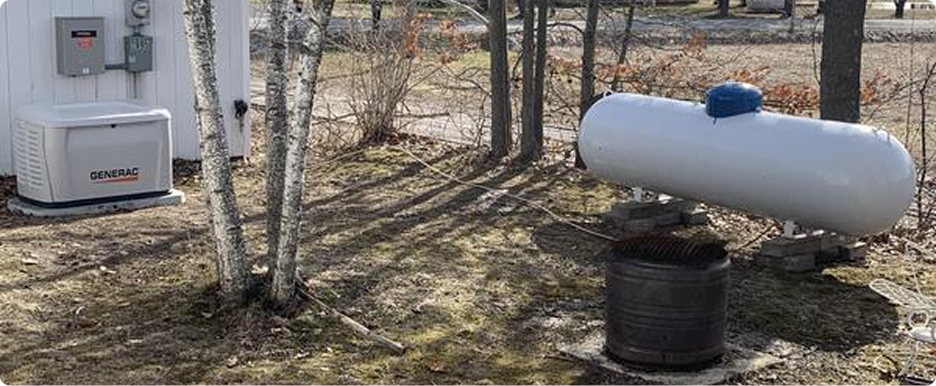
If you’re looking for a more hands-off option, this is it. Natural gas generators connect directly to your home’s existing gas utility line. Since fuel is supplied continuously through the utility system, you don’t have to store fuel on-site or manually refill the tank under normal operating conditions. 

For many homeowners, that’s a major advantage. There’s no tank to monitor and no need to schedule refuels after a storm. In general, natural gas systems tend to require less fuel management over time.

That said, natural gas depends on your local utility infrastructure. While gas systems generally remain operational during outages, earthquakes, severe weather, other disasters might interrupt service indefinitely.


leaf icon

Propane Generators


Instead of relying on a gas utility line, propane generators use fuel stored on-site in a dedicated tank installed on the property. This setup gives homeowners more independence from utility infrastructure, making propane a common choice in rural areas without natural gas service.

Because the fuel supply is stored on-site, runtime depends on tank size and fuel levels. Larger tanks can support longer operation, but homeowners still need to plan for refills during extended outages.

That planning becomes especially important after major storms, when high regional demand can create delivery delays or refill bottlenecks. Propane systems also require space for tank installation, which may influence placement and permitting considerations.


Still debating? Take a look at the table below for a side-by-side comparison.

Factor Natural Gas Propane What it means for homeowners
Fuel source Utility gas line On-site propane tank Fuel availability depends on local service and home setup
Storage No on-site tank managed by homeowner Requires tank storage Propane requires more active fuel planning
Runtime planning Tied to gas service availability Tied to tank size and usable fuel level Both require professional planning for long outages
Best fit Homes with existing natural gas service Homes without natural gas or in rural areas Availability often drives the choice
Installation considerations Installation considerations Gas line and meter capacity assessment Professional installation guidance is important
Disaster considerations Service can be interrupted or shut off in some events Stored supply is finite and refill access can be delayed No fuel source is risk-free in every emergency
Ongoing logistics Less homeowner-managed fuel handling Tank checks and refill scheduling Propane requires more ongoing fuel management
Cold weather considerations Generally tied to utility service reliability Propane vaporization can be affected by cold Cold climates may need extra propane planning
Resupply considerations Utility dependent Delivery dependent Extended outages should be planned before storm season


Can a Propane Generator Run on Natural Gas? 

All Generac whole-home backup generators are dual-fuel capable, meaning they can be configured to run on either natural gas or liquid propane.

Natural gas and propane have different pressure and combustion requirements, so switching fuels typically requires professional configuration during installation. Some units are built as dedicated systems for one fuel source, while others may allow approved field conversion.

Because fuel setup affects safety and warranty coverage, any conversion or configuration change should always be handled by a qualified installer.


How Much Fuel Does a Home Generator Use?

Fuel consumption depends on several factors, including generator size, electrical load, fuel type, weather conditions, maintenance and how long the generator runs during an outage.

What you choose to power also makes a difference. A generator supporting only essential circuits will typically use less fuel than a system running most or all of the home, especially when large appliances or HVAC systems are involved.

At Generac, we publish approximate fuel consumption rates for our home standby generators, but actual usage can vary by model and operating conditions. Homeowners should always reference their generator’s spec sheet, installation manual or fuel data decal for exact numbers. Your home's gas meter should also be capable of supporting both generator fuel flow and other household gas loads at the same time.
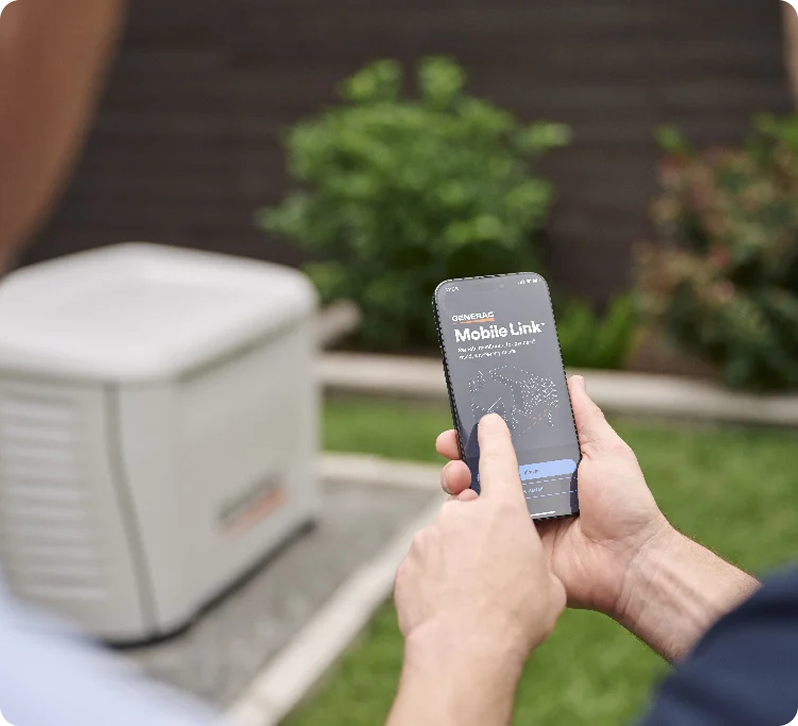
Home standby generator monitored using the Mobile Link app
Quick Tip

Generac Mobile Link makes it easy to keep an eye on your system after installation. You can check generator status, monitor runtime, receive maintenance reminders and connect with service support—all from your phone.

If you have a propane-powered generator, Generac's optional Fuel Monitor can also display propane tank levels in the app, giving you one more way to stay prepared for the next outage.

Planning for Extended Power Outages

If your generator runs on propane, your tank size has a direct impact on runtime. A larger tank will keep you going longer, but it’ll need a refill eventually. Regional demand for fuel tends to spike in the days after major storms, so it’s best to plan for possible shortages or delivery delays. Some homeowners choose to establish a relationship with a local propane provider before outage season starts. That way, they’re already set while others fight for their spot on the delivery schedule.

Planning is easier when you can keep a close eye on your fuel levels. Our monitor allows you to view tank levels through Mobile Link. It also sends low-fuel alerts and tracks usage trends—all helpful to know as you plan for extended outages.

A few simple load-management habits can also help stretch your reserves when fuel is scarce. Running only essential appliances, staggering heavy electrical loads and limiting unnecessary energy use can reduce overall fuel consumption.

Before outage season, it’s a good idea to:

  • Check propane tank levels regularly
  • Inspect visible fuel lines and connections
  • Confirm gauges and monitoring systems are working properly
  • Schedule generator maintenance ahead of severe weather
  • Keep fuel provider contact information easy to access

Solar Loan: Ownership with Monthly Payments

A solar loan allows you to own your system from day one without the upfront investment. Many lenders offer $0 down payment plans, however interest rates vary and can decrease the overall return over the life of the system when compared to paying cash.
Why homeowners choose it:
  • Little to no upfront cost
  • You still own the system
  • Fixed monthly payments in many cases
  • Some lenders may cover the cost of solar, battery storage, and home generators
Things to consider:
  • Total cost is higher over time compared to cash due to interest
  • Loan terms and rates vary by lender
  • As the system owner, you are responsible for maintenance and repairs
  • Not eligible for 30% federal tax credit
For many homeowners, a solar loan strikes a balance between affordability and ownership. Monthly payments are often designed to align with—or fall below—what you were previously paying your utility company, while you still benefit from offsetting utility costs with solar power.

Solar Lease: Low Upfront Cost Without Ownership

With a solar lease, a third-party provider installs, owns, and maintains the system, and you pay a fixed monthly fee to use it over a set term—typically 20–25 years. Most solar leasing companies offer $0 down options and monthly payments can even be lower than your current utility bill. 
 
In some cases, this structure is marketed as a subscription model, where you’re paying for ongoing access to solar energy without owning the equipment. 
 
Where the 30% federal tax credit comes in: The  residential tax credit  may have expired at the end of 2025, but with third-party ownership (TPO), the solar leasing company still qualifies for the 30%  commercial tax credit and is able to pass on savings over the life of your lease.
Why homeowners choose it:
  • Little to no money down
  • Fixed monthly payments
  • Service and maintenance obligations are typically handled by the provider
  • Some providers may cover the cost of solar, battery storage, and home generators
  • Leases can typically be transferred to a new homeowner in the case that you sell
Things to consider:
  • You don’t own the system
  • Long‑term savings are typically lower than cash or prepaid lease options
  • Only system owners are eligible for state-level tax incentives or rebates
  • Some plans may include a rate accelerator that increases your payments over time
Leases can be attractive for homeowners who want to avoid upfront costs and ownership responsibilities, while still benefitting from savings from solar and backup power if battery storage and/or a home generator is included.

Power Purchase Agreement (PPA): Pay Less for the Power You Use 

A PPA is another third‑party ownership option offering low or no upfront costs, but instead of a fixed monthly lease payment mentioned above, you pay for the actual electricity the solar panels produce, typically at a lower rate than your utility. 
 
Similar to a standard solar lease, the solar leasing company still qualifies for the 30% solar tax credit and should factor in those savings to your rate.
Why homeowners choose it:
  • Little to no money down
  • You pay for energy at a set rate, often lower than utility electricity
  • Service and maintenance obligations are typically handled by the provider
  • Some providers may cover the cost of solar, battery storage, and home generators
Things to consider:
  • You don’t own the system
  • Long‑term savings are typically lower than cash or prepaid lease options
  • Monthly costs vary based on usage
  • Only system owners are eligible for state-level tax incentives or rebates
Because you’re paying for power rather than equipment, it can feel similar to a traditional utility bill—just with a lower rate and powered by solar.

Prepaid Solar Lease: Lower Cost Path to Ownership

A prepaid solar lease offers a hybrid approach between ownership and traditional leasing. Instead of making monthly payments, you pay upfront for the system’s expected energy production over the life of the agreement, often at a discounted rate.  
 
The solar leasing company still installs, owns, and maintains the system while under lease, and is able to pass on savings from the 30% commercial solar tax credit. 
 
System ownership can then be transferred to the homeowner after a defined period, but no sooner than year six based on federal tax credit eligibility rules.
Why homeowners choose it:
  • Lower total cost than many traditional cash, lease, or loan options
  • No ongoing monthly payments for energy from the system
  • Service and maintenance obligations are typically handled by the provider while under lease
  • Opportunity to take ownership of the system after a set period
  • Certain providers will cover the cost of solar and battery storage systems
Things to consider:
  • Requires an upfront payment (or financing for that payment)
  • You don’t own the system during the initial term
  • Terms and buyout options vary by provider 
  • Only system owners are eligible for state-level tax incentives or rebates 

For homeowners looking to balance upfront savings, long-term value, and future flexibility, a prepaid lease can be a compelling middle ground between owning and leasing a system. 

Cash Purchase: Maximum Long‑Term Value 

Paying cash means purchasing your home energy system outright—whether that’s solar panels only, or you opt to include solar battery storage and/or a home backup generator for resilience. Because you're not making loan or lease payments, the energy savings go directly to your bottom line—maximizing your long-term savings on utility costs.
Why homeowners choose it:
  • You own the system from day one
  • No monthly loan, lease, and in some cases, energy payments
  • High long‑term return
  • Take advantage of local incentives and rebates
Things to consider:
  • Requires a higher upfront investment
  • Payback happens over time, not immediately
  • As the system owner, you are responsible for maintenance and repairs
  • Not eligible for 30% commercial tax credit
A cash purchase often makes sense for homeowners who plan to stay in their homes long term and want to maximize value over the life of the system. Once the upfront cost is paid, the energy your system produces can significantly reduce your reliance on the grid.


Frequently Asked Questions

Have questions? We’ve answered some of the most common ones. If you don’t see what you’re looking for, your local dealer can help with answers specific to your home, or visit our Support Center for more details.

Homeowners typically have several ways to pay for solar panels and related home energy solutions, including: cash purchase, loan, lease, Power Purchase Agreement (PPA), and prepaid lease. Each option offers a different combination of upfront cost, monthly payments, ownership, and long-term value.  

There’s no single “best” financing option—it depends on what matters most to you. The best option for you will be one that aligns with your financial capabilities and goals, how long you plan to stay in your home, and whether you’re looking to build a more comprehensive home energy system over time.

  • Best long-term return: Cash purchase or prepaid lease
  • Lowest upfront investment: Loan, lease, or PPA
  • No monthly payments: Cash purchase or prepaid lease
  • Predictable monthly payments: Lease or loan
  • System ownership: Cash purchase, loan, or prepaid lease
  • Lowest ownership commitment: Lease or PPA
  • Captures 30% tax credit: Lease or PPA

The main difference comes down to ownership. 

With a solar loan, you borrow money to purchase the system and own it from day one. This allows you to benefit directly from energy savings and system ownership over time.

With a solar lease, a third-party provider owns the system, and you pay a fixed monthly fee to use it over a set term. Because a third-party provider owns the system, leased systems are also eligible for the 30% solar tax credit.

Solar financing allows homeowners to install solar panels without paying the full cost upfront. The goal is to make solar more accessible by spreading out costs over time or reducing upfront investment.

Depending on the option you choose, you may:

  • Make monthly loan payments towards ownership
  • Pay a fixed monthly lease payment to use the equipment
  • Pay for the energy produced (PPA) without owning the system
  • Prepay the lease cost upfront at a discounted rate

Some options also allow you to bundle additional components, like battery storage or a backup generator, into a single financing structure.

For many homeowners, solar financing makes going solar more accessible by removing the need for a large upfront investment. That means you can begin capturing savings on your energy bills sooner, with overall value depending on your financing terms, energy usage, local utility rates, and how long you plan to stay in your home.

Yes—some financing providers offer packages to finance solar panels and battery storage as part of the same payment plan.

Bundling solar and storage can:

  • Provide backup power during outages
  • Help you store and use more of your solar energy
  • Simplify installation and financing into a single plan

Yes, as the home energy market evolves, more lenders and providers now offer bundled financing options that can include solar, battery storage, and backup generators. This approach allows homeowners to combine savings from solar with reliable backup power, often with low or no upfront cost.


The Generac Advantage

Generac has been a leader in home backup power for decades. With a range of flexible home energy solutions including solar power, battery storage, backup generators, and smart energy management—our products are designed to work together seamlessly, providing homeowners with:

Proven Reliability

Automatic Operation

Professional Installation & Service

Scalable Home Energy Solutions


Your local Generac dealer can assess your home’s energy needs and recommend the right home energy solution, and payment plan, for your home. 

Connect with a Dealer

Related articles